


Sales Enablement Is a System: How to Drive Adoption, Not Just Asset Creation

Categories


Sales Enablement Is a System: How to Drive Adoption, Not Just Asset Creation
Here’s a scenario most B2B marketing and sales leaders know well: the battlecards are built, the training is done, the pitch deck has made the rounds more than once and still, deals are progressing without using them.
Most B2B sales teams have plenty of sales enablement content. The real problem isn’t what’s been built, it’s whether it’s actually getting used. And if it’s not getting used, it’s not driving revenue.
A content approach asks: “What do we need to create?”
A system approach asks: “How will this actually get used in a deal?”
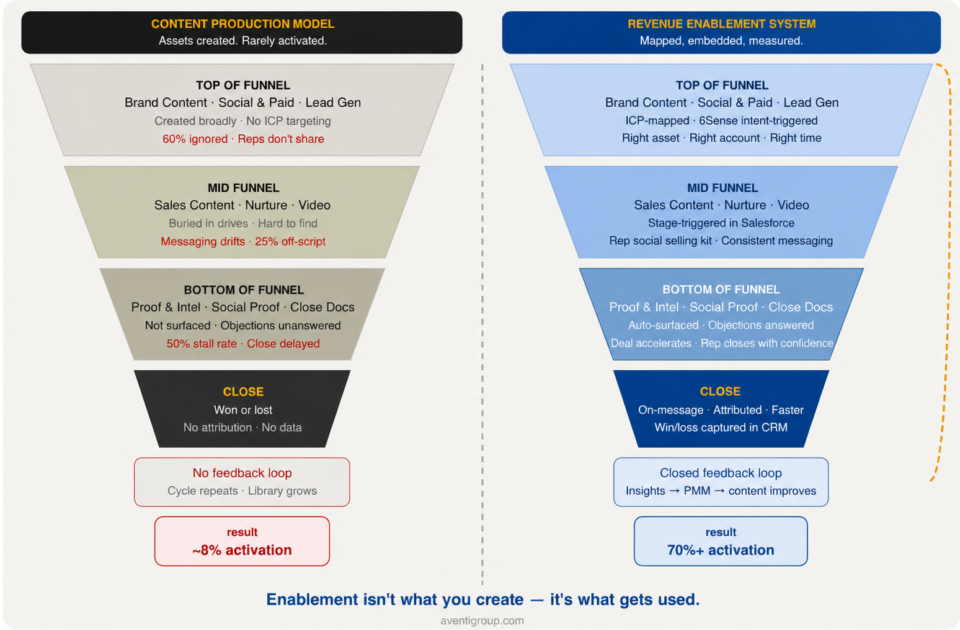
That shift, asking how content will be used to close a deal and what messaging is actually resonating with late-stage prospects, changes everything: how you build content, where you publish it, how you measure success, and how you manage it in your tech stack.
A real enablement system maps content to the buyer journey so BDRs and reps always know what to use and when. It surfaces assets inside the CRM, sales sequences, and email platforms not buried in a shared drive. It reinforces messaging continuously, not just at kickoff. And it runs a feedback loop that brings real field insights back to product marketing, so content stays current, relevant, tied to what’s actually moving deals and product marketing has valuable, iterative insights.
That shift changes everything: how you build content, where you publish it, how you measure success, and how it lives inside the tools your sales team already uses every day.
Why This Matters for Revenue
When content delivery is tied to intent signals and deal stage, adoption goes up because the content is relevant, not just available. That’s the difference between a library and a system.
In our own ABM work at Aventi, running campaigns across 6Sense, HubSpot, and Salesforce for a B2B fintech client, we generated $2.5M in pipeline and $1M in closed revenue not by creating more content, but by making sure the right content reached the right people at the right stage.
Five Steps To Build Your Sales Enablement System
1. Connect to revenue goals. Tie every enablement effort to pipeline growth, deal velocity, competitive win rate, and average contract value. If it doesn’t connect to a revenue metric, question why it exists.
2. Map content to the buyer journey. Every asset needs a clear home in the sales process: which stage, which objection, and what the rep should say alongside it. When reps have that clarity, they use the content.
3. Embed into your sales tools. Surface content directly inside your CRM and sales engagement stack at the stage where it’s most relevant. Use intent data from tools like 6Sense to trigger the right asset at the right account at the right moment.
4. Measure what moves deals, not what fills libraries. Track content influence on pipeline, engagement by deal stage, and whether deals that use enablement close faster than those that don’t. Downloads are a vanity metric. Revenue attribution is not.
5. Build feedback loops. Run regular win/loss reviews. Ask your BDRs and reps what’s missing. Retire what’s outdated. Fill real gaps, not assumed ones. This is what keeps the system compounding over time.
What the Best Teams Do Differently
High-performing GTM teams treat enablement like a product, not a project. They keep their content portfolio lean and governed. They review what’s being used and cut what isn’t. They treat every asset as something to be created, activated, measured, and eventually retired.
Most importantly, they build for how sellers actually work, not how marketing assumes they should.
The Bottom Line: More Content Is Not the Answer. A Better Revenue Enablement System Is.
The shift from content production to revenue enablement is what allows GTM teams to scale consistent messaging, compress deal cycles, and demonstrate clear influence on revenue outcomes, which brings us back to where we started: the problem was never the content. It was whether anyone was actually using it.
Produce less. Activate more. Build the feedback loops to know the difference.Ready to build a system, not just a library? Aventi Group’s sales enablement services can help. Let’s talk.