

Categories


“AI-powered” is table stakes now, not leverage
Most GTM teams claiming “AI-powered” haven’t measured what it actually does. That’s not a knock. It’s just where the market is right now. And the gap between claiming and proving is exactly where differentiation lives.
Here’s the uncomfortable math: a 2024 analysis of G2 software listings found more than 85% of B2B SaaS products now include some form of AI claim in their positioning. Buyers have absorbed thousands of “AI-powered,” “AI-driven,” and “AI-first” impressions. The phrase has become the new “cloud-based,” which is to say, it means nothing on its own.
The claim isn’t wrong. It’s just noise.
The AI-Powered Graveyard: Why Your Claim Doesn’t Land
Saturation killed differentiation
When every product in a category shares the same descriptor, the descriptor disappears. It stops being a signal and starts being background radiation. Buyers don’t read “AI-powered” as a competitive advantage anymore. They read it as table stakes, like “SaaS” or “scalable.” If you’re spending PMM cycles crafting AI-forward messaging that sounds like your five closest competitors, you’re not differentiating. You’re blending.
Buyers hear “AI-powered” as “we bought a tool.” There’s a reason this claim doesn’t move deals.
Buyers, especially technical and economic buyers with CFO pressure, translate “AI-powered” into one of two things: “they integrated an LLM” or “they added a Copilot feature.” Neither of those translates to a business outcome. Transformation is a before-and-after story. “We have AI” is not that story.
The Hard Truth About AI in GTM
The real question isn’t “do we have AI?” It’s “can we measure what it does?”
And honestly? Most teams can’t. Not because they’re unsophisticated, but because the measurement discipline hasn’t kept up with the tool adoption. Marketing ops leaders are sitting on AI tooling across content, research, campaign execution, and sales enablement, but the KPIs haven’t changed to reflect that investment. Boards and CFOs are asking for ROI on AI spend, and the answer is still often “we’re moving faster” without a number behind it.
Three patterns show up in teams that have made the shift from claiming to proving:
- They picked two or three operational metrics and held them. Content velocity (assets per sprint, time from brief to draft). Sales cycle length. Win rate on competitive deals. Not everything, not a dashboard of 40 vanity metrics.
- They built proof before they rebuilt the message. The case study or internal benchmark came first. The positioning came after, because it had something to stand on.
- CMO, CRO, and PMM agreed on the same definition of success. Sounds obvious. Almost never happens without intentional alignment work.
What Actually Differentiates Now (Hint: It’s Boring)
Differentiation in an AI-saturated market comes from things that are harder to copy than a feature: operating model maturity, measurement discipline, and execution clarity.
Operating model maturity means your content, sales, and product teams are moving in the same direction at the same speed, with AI embedded in the workflow rather than bolted on. It shows up as faster time-to-launch, tighter feedback loops between sales and PMM, and content that actually gets used in deals.
Measurement discipline means you’ve defined the delta. Before AI, we produced X assets per quarter. Now we produce Y. Before AI, average deal cycle was N days. Now it’s N-minus-something. That delta is your proof point. It’s also your message.
Execution clarity means everyone in the GTM motion, from the CMO presenting to the board to the SDR opening a cold email, can explain what AI is actually doing for the customer. Not the feature. The outcome.
How to Reposition Without Saying “AI”
Move to outcome framing. Let AI be the footnote, not the headline.
Instead of: “Our AI-powered platform accelerates pipeline generation.”
Try: “Teams using [product] close competitive deals 22% faster.” Then, in the supporting copy, explain that AI-driven prioritization is part of how that happens.
The product’s intelligence becomes proof, not positioning. Buyers infer the technology from the outcome. You don’t have to announce it.
Build the proof first. One real before-and-after case study, one comparison showing operational KPIs shifting, one sales deck slide with a customer’s actual number, is worth more than any amount of AI-forward language in a homepage hero.
Then rebuild your GTM narrative around maturity and capability, not tools. “We help teams do X faster” is a more defensible position than “we use AI,” because it describes something a buyer can evaluate, verify, and ultimately trust.
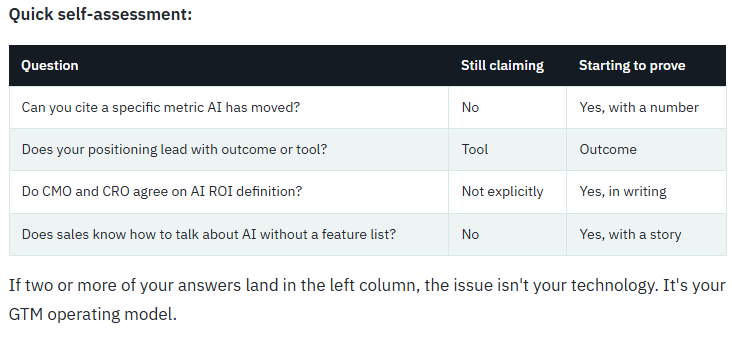
The Maturity Check: Is Your AI Strategy GTM-Ready?
Symptoms you’re stuck in “AI-powered” claims:
- Your messaging leads with AI and follows with outcomes (instead of the reverse)
- You can’t cite a specific metric that has moved because of AI adoption
- Sales doesn’t know how to explain what AI does in a conversation without reading a feature list
- Your AI narrative sounds like your competitors’ AI narrative
Symptoms you’re using AI to actually transform GTM:
- You have a before/after operational benchmark (content output, pipeline velocity, sales cycle)
- Your PMM team is measuring content velocity as a standard sprint KPI
- AI tools are embedded in your content and enablement workflows, not evaluated as experiments
- Your positioning leads with outcomes and cites AI as the mechanism