Categories


Why Our Team Relies on Kanban to Keep Client Work Moving
At Aventi Group, a lot of our work involves the kind of projects that touch nearly every part of a client’s marketing at once. A brand change can mean updating hundreds of assets, and new messaging after an acquisition has to tell one story that makes sense to everyone who hears it. Sales enablement programs and product launches add their own layers, on a schedule that rarely has much room to spare.
With so many people and moving parts on the client side, staying organized matters as much as getting the strategy right.
Over the years I’ve watched teams try just about every project management approach you can name, and most struggled once they met the realities of client work, where timelines slip and priorities change mid-week.
Our team has settled on Kanban, and from where I sit as a partner, it has made a real difference in how smoothly large projects run.
Everyone works from the same picture
Our team manages several client relationships at once, each with multiple projects in progress, and organizes that work on Kanban boards that give everyone a shared view of every account:
How it works
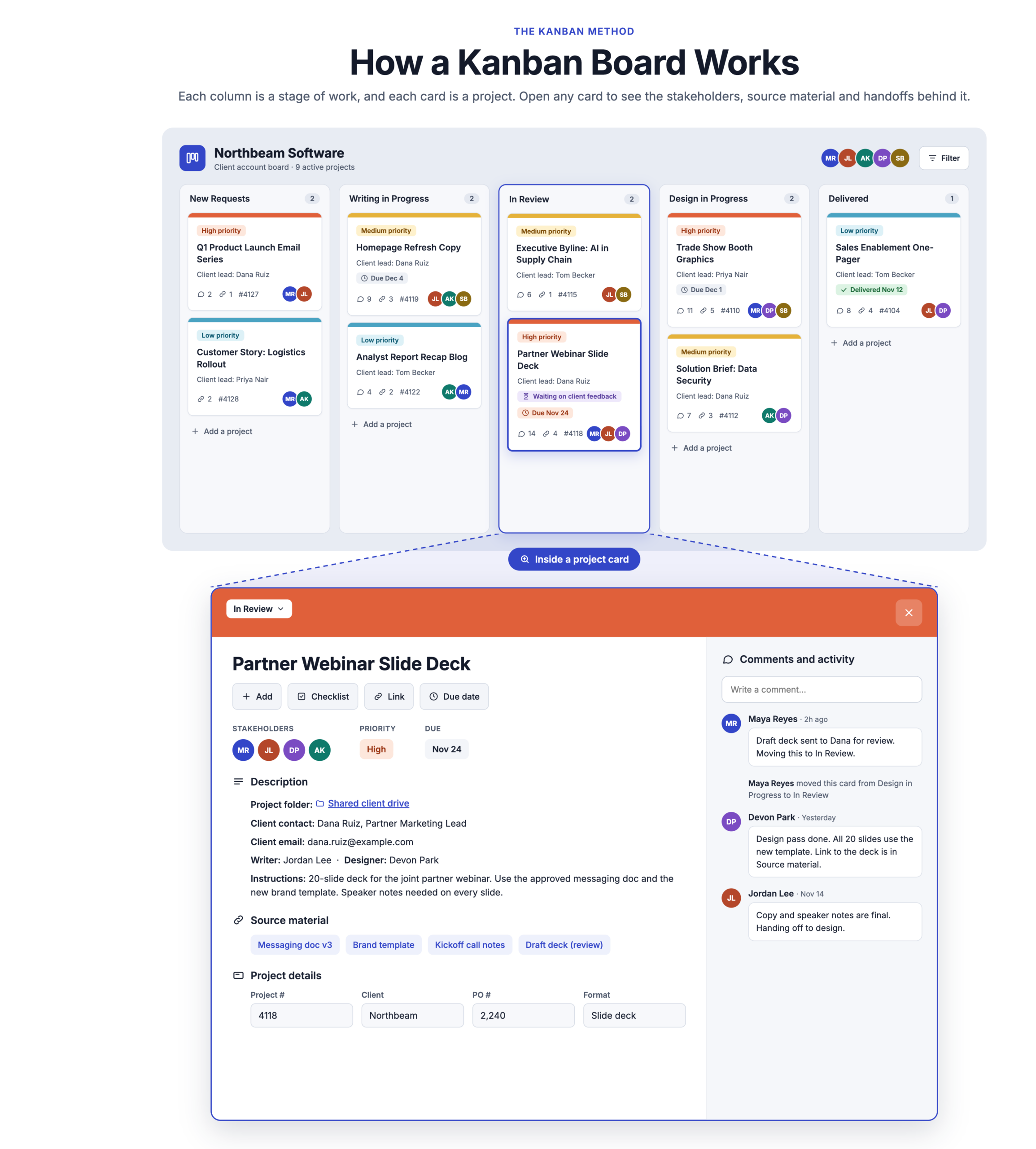
- Every project has its own card, which holds the project name, the stakeholders involved, and links to the relevant source material.
- The columns on the board show exactly where each project stands, so anyone can check status without sending an email or scheduling a meeting.
- When I look at a client’s board, I can see the state of the entire account in a few seconds and walk into client conversations already up to speed.
- Team members can see what their colleagues are working on and waiting for, which makes the handoffs between writing, review, and design much smoother.
That shared view means less time chasing updates and more time moving work forward.
The process reflects how work really happens
What I appreciate most is that the boards show the honest version of a project rather than an idealized one. Whether it’s a single datasheet or one piece of a larger launch, a typical project moves through these stages:
- New project, where the team gathers the brief, scope, and source material.
- Copy in progress, where a writer drafts or updates the content.
- Stakeholder review, where the client’s team checks the content for accuracy and messaging.
- Design in progress, where approved copy is laid out by our designers.
- QA, a final check that the copy and design both landed correctly.
- Done, once the project is delivered and signed off.
In practice, copy and design each usually take a few rounds before they’re approved. Because the team builds those loops into how they track work, they can set realistic expectations from the start instead of treating a normal review cycle as a delay.
Problems surface early
The greatest value of the boards, in my view, is what they reveal about where attention is needed. A few of the signals the team watches for:
- When a project has been sitting in stakeholder review longer than usual, the team knows which client contact to follow up with.
- When several projects are bunched up in design, it’s a sign that it’s time to look at capacity or adjust priorities.
- When a project keeps cycling between copy and review, it often means the brief needs another conversation with the client before more drafts go out.
Catching these early leaves room to adjust long before a deadline is at risk.
Structure with room for judgment
Many Kanban teams set strict limits on work in progress, but in agency work a delay often has a perfectly reasonable explanation, like a client’s team being away at a conference.
Our team uses the board to decide whether a delay calls for action or just a timeline update, and sets up boards to fit each client rather than forcing one format on everyone.
What our clients gain
For the companies we work with, the benefits show up in a few concrete ways:
- Fewer surprises, because issues are visible well before they affect a deadline.
- One source for all communication and version control for the various deliverables/assets.
- Quicker answers when they ask about the status of a deliverable.
- A team that is usually following up on open items before the client has to raise them.
During a launch or rebrand, when the pressure is highest, that kind of reliability is a big part of why our clients keep coming back.
If you’re looking for a better way to manage your own team’s projects, start with a single workflow you already run. Map out the steps honestly, including the review cycles and approval delays that most plans leave out, and give every project its own card. In my experience, the board starts pointing people toward the right conversations much sooner than you’d expect.